Sustainable community development and climate action require transdisciplinary approaches and research collaboration (Bradford, 2003; Dale et al., 2010, 2012). To this end, we have created the online collaboration platform: Community + Collabotation + Sustainability = CoLabS. CoLabS makes it easy to create scalable research networks, and it can be customized for the needs of different user communities. The platform complements face-to-face meetings with a virtual meeting space, equipped with video calling, messaging, and file sharing capabilities. In addition, while the community can collaborate in a private space, CoLabS also contains a public library and a space for sharing reports, videos, and any other useful resources. We envision a network of connected hubs across Canada, for communities to easily work together and with one another to push emerging sustainability initiatives forward.
To learn more about the platform, read our paper on its development (Jost et al., 2021).
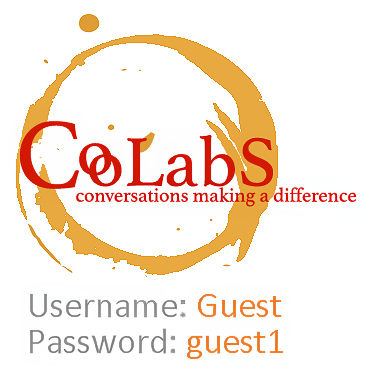
To try out the site, click the image below, and use the guest password displayed under the CoLabS logo.
CoLabS is an open-source, Drupal-based platform, and you are welcome to replicate it on your own website (click here to download the CoLabS image pack). If you and your community are interested in using the platform for a community sustainability research project, you are welcome to contact the CoLabS research team to learn more. The platform was designed to be flexible, with the ability to incorporate and embed new tools, depending on the needs of the user community. We have compiled a library of open-source/free-version tools that can be integrated into CoLabS, and these can be found by clicking and expanding the categories below.
Padlet provides multiple canvas-based tools for sharing resources, ideas, and links. The canvases can be embedded into CoLabS pages, and CoLabS communities can use these canvas boards to post ideas, images, and links related to their projects.
Trello provides a suite of project management tools, such as boards for posting ideas and resources, calendars, and project timelines for tracking progress. Trello boards and cards can be embedded into CoLabS pages, and they can be used by CoLabS communities as tools for organizing and keeping track of project tasks.
Lino is a sticky-note tool for sharing ideas and links. Lino boards can be embedded in CoLabS pages, and CoLabS users can use these boards to post ideas and brainstorm around projects.
Wakelet is a tool for creating collections of images, links, videos, and other resources. Wakelet collections can be embedded into CoLabS pages, and these collections can serve as libraries for projects lead by CoLabS communities.
Scrumblr is an easy-to-use sticky-note tool, which provides boards for posting and arranging messages and ideas. CoLabS users can integrate Scrumblr into their project work in order to help them organize their thoughts.
Pydio is a file directory tool for uploading and organizing documents, images, and other resources. Pydio directories can be integrated into CoLabS community sites to support the storage and sharing of project documents and files.
Gliffy is a tool for creating diagrams of systems and networks, as well as flowcharts and other types of diagrams. Gliffy can be used by CoLabS communities to create diagrams of systems, networks, concepts, and relationships related to their projects, and these can then be embedded on their CoLabS community sites.
Kumu is a tool for visualizing systems and networks, and it can be used to create interactive diagrams, with descriptions of elements and relationships that appear when clicking on them. CoLabS communities can use Kumu to capture and communicate information about systems or networks relationships that are relevant to their projects, and these can be embedded on their CoLabS community sites.
Insight Maker is a tool for modelling systems and running simple model simulations. CoLabS communities can use Insight Maker when their projects involve modelling and simulating systems dynamics (however, note that Insight Maker is useful for relatively simple models, but it is not as powerful as other systems modelling and simulation applications).
Tableau is a tool for visualizing data and creating interactive graphs that can be embedded into webpages. CoLabS communities can use Tableau to create and share data visualizations related to their projects.
Plotly is tool for collaboratively creating data visualizations. CoLabS communities can use Plotly to visualize data collected through their projects, and as they collect more data, CoLabS users can collaborate on these data visualizations by updating the graphs.
Mapbox is a tool for creating online interactive maps. Mapbox maps can be embedded into CoLabS webpages, and CoLabS communities can use Mapbox to display and share geographical information related to their projects.
Leaflet is a javascript library for developing customizable, interactive maps. CoLabS communities can use Leaflet to create maps with features such as filters and pop-ups, and these maps can serve as platforms for organizing and communicating geographical data related to their projects.
ZeeMaps is a tool for creating customizable maps that can incorporate various forms of media, such as images and videos. CoLabS users can integrate ZeeMaps into their CoLabS community sites to share geographical information and relevant links, images, and videos.
Snazzy Maps is a tool for customizing Google Maps and embedding these maps on websites. CoLabS users who wish to share maps created using Google Maps can use Snazzy Maps to customize these maps and embed them on their CoLabS community sites.
Whereby is an easy-to-use video conferencing application that does not require downloading software. CoLabS users can create Whereby meeting rooms for their communities and projects, and these meeting rooms can be embedded on their CoLabS community sites.
UberConference is a browser-based video conferencing application that does not require downloading software. CoLabS users can create Uber Conference meeting rooms for their communities and projects and include links to these rooms on their CoLabS community sites.
Flipgrid is tool for posting and responding to topics through video clips. Flipgrid can be embedded on CoLabS community sites, and CoLabS communities can use the tool to explore and discuss topics and challenges related to their projects using a video format.
Yammer is a Microsoft-owned tool that can be used for text communication and sharing resources and links. Yammer can be integrated into CoLabS community sites as tool for CoLabS users to discuss ideas for and potential approaches to their projects/
Bradford, N. (2003). Cities and communities that work: Innovative practices, enabling policies. Canadian Policy Research Networks Inc. (CPRN), Ottawa.
Dale, A., Newman, L., Ling, C. (2010). Facilitating transdisciplinary sustainable development research teams through online collaboration. International Journal of Sustainability in Higher Education, 11(1), 36–48. doi: 10.1108/14676371011010039
Dale, A., Dushenko, B., & Robinson, P. (2012). Urban sustainability: Reconnecting space and place. Toronto: University of Toronto Press.
Jost, F., Newell, R., & Dale, A. (2021). CoLabS: A collaborative space for transdisciplinary work in sustainable community development. Heliyon, 7(2), e05997. doi: 10.1016/j.heliyon.2021.e05997